
This is a nod to an article in La Presse (see here) that I found very interesting and colourful about the perspective of investors and the psychological biases that often affect investment decisions.
The4th quarter of 2023 did not disappoint in terms of the returns it brought us. In fact, it was mainly the months of November and December that did most of the work after three more disappointing months in August, September and October. It just goes to show that the stock markets never go in a straight line, when you look at the whole year, we had a year in three stages. From January to the end of July, the markets mostly performed well. Then, from August to September was much more difficult with some stock markets that went into correction territory (drop of 10% or more). Finally, to end the year on a good note, November and December were very good for virtually all asset classes with equities and bonds rising sharply.
A person who would have only looked at his portfolio at the beginning of the year and at the very end will find that the year has been very good. The one who looks at her wallet every day will also have had a very good year, but she will have experienced a greater roller coaster of emotions with the significant rises and falls at certain times of the year.
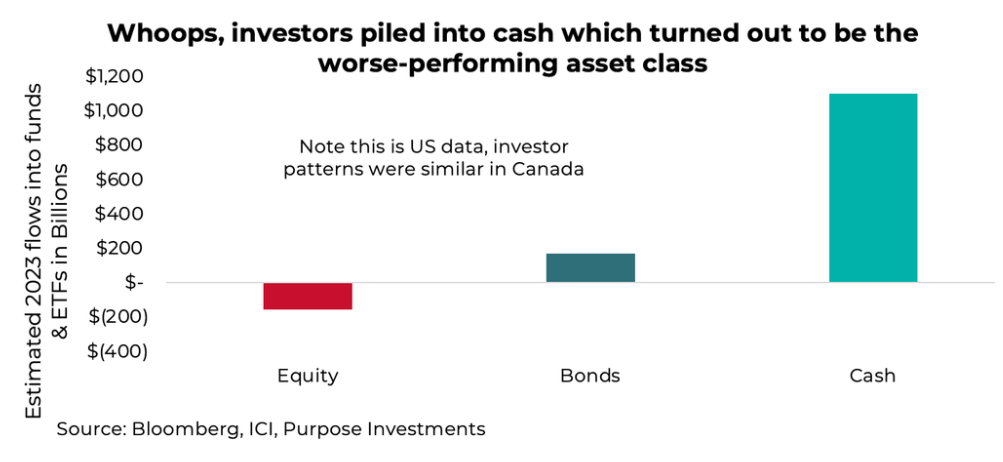
With this excellent performance of the markets (especially in equities) in 2023, where do you think people have invested in the majority? And yes, in the asset class that has yielded the least of the year; cash. After a challenging 2022, investor appetite for risk assets was low; It just goes to show that “buying when prices are low” is easier said than done. It is this aspect of behavioural finance that is discussed in the La Presse article cited above.
2023, like many years, brought its share of bad news. In addition to high inflation, we have seen some of the largest bank failures in history with the fall of Silicon Valley Bank, Signature Bank and First Republic in the United States. While some were proclaiming the collapse of the American banking system, this was not the case. Second, with the economy continuing to operate at full capacity and inflation remaining high, 10-year government bond yields in the U.S. reached 5% over the summer; This is the highest in more than 15 years. Mortgage rates have also reached their highest level since the early 2000s. As if that wasn’t enough bad news, the war in Ukraine has continued, and a new war has broken out between Israel and Hamas. Despite this, several stock markets around the world had an excellent year.
100% chance of recession
This is what was predicted in the next 12 months by Bloomberg Economics’ probability models in October 2022 (source). This was not the only prediction at the end of 2022 for the year 2023, which will have been completely “off track” in good French. Indeed, when we look at the forecasts that were made at the end of 2022, we quickly realize that the vast majority of strategists and forecasters were “in the field”. While we were hearing about the most telegraphed recession in history and the average analyst forecast that the US stock market index of the S&P500 would end the year 2023 at a level around 4000; nothing has happened. The U.S. economy is not in recession and the S&P500 index ended the year at 4772, about 19% higher than expected.
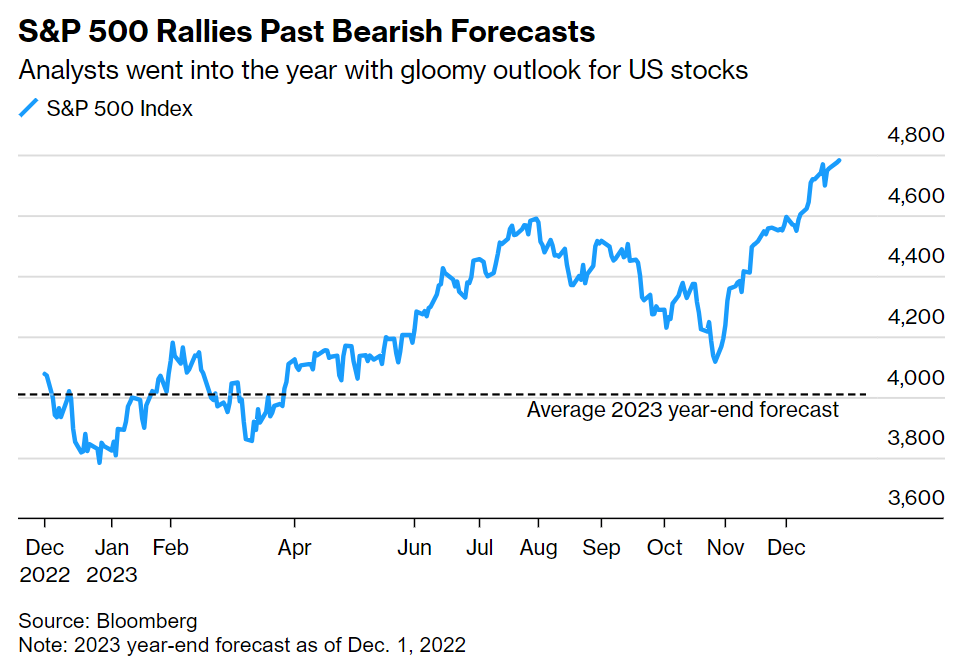
Strategists at the world’s largest financial institutions such as Goldman Sachs, JPMorgan and Morgan Stanley predicted a difficult first half of 2023. In the end, the US stock market represented by the S&P500 index will have risen by about 16%between January 1 and June 30, 2023.
In closing, as you have read or heard me many times on this subject; It is impossible to predict the results of the stock market in the short term. Some people manage to do it from time to time, but they often missed a lot of predictions before succeeding in one. What we do know is that over the long term it rises more often than it falls, and trying to predict its short-term movements is often more expensive than letting storms pass. You just have to have the discipline and emotional control to keep your plan and goals in sight when you’re in the eye of the storm.
The recession
Now that 2023 is over, this does not mean that the topic of recession is over. There is always a possibility that there will be, both in Canada and in the United States. In fact, it’s possible that we’re already in a recession in Canada because, as I’ve mentioned in one of my articles in the past (see here), recessions are usually made official long after they’ve begun. In this article, I also covered the impact of recessions on the stock markets and on your portfolios.
The current economic situation is often compared to what happened between 1981 and 1982. In the early 1980s, the U.S. Central Bank (FED) aggressively raised interest rates to combat strong inflation growth. The US stock market (S&P 500) had fallen by 27% between its peak and its trough (compared to a 25% drop between January 4 and October 12, 2022). In the 12 months following the peak of inflation, the US stock market had rebounded very strongly. Sound familiar?
In this regard, the official recognized dates of the recession of the years 1981-1982 in the United States are from July 1981 to November 1982. How has the US stock market performed over this period, you ask? +9.76% in Canadian dollars. Why? Because as I often say, the financial markets are always looking to the future. Even if the situation at a particular time is difficult, if there is a possibility that it will improve in the future; That’s what the stock market will be watching. This is also why it is not uncommon to see the stock market decline before recessions and rise during recessions.
For 2024
Progress on inflation continues, but data like December’s show that the battle is not won. We should also have seen the ceiling on interest rates, even though interest rate cuts are expected later in 2024; both in Canada and the United States. However, central banks around the world will continue to monitor inflation closely to see when the first rate cuts will be. They will want to avoid lowering them too quickly and thus creating a rebound in inflation that could lead to new problems.
The U.S. economy continues to do well, but the Canadian economy has slowed. You may recall other articles where I mentioned that the U.S. economy was able to sustain more interest rate hikes than the Canadian economy; Well, we’re now starting to see that difference come to fruition.
In conclusion, we will also be treated to a presidential election in the United States in 2024. I won’t comment on the potential winner, but I’ll leave you on a positive note; In general, U.S. presidential election years are good years on the stock market.

Do not hesitate if you have any questions or would like to discuss them further.