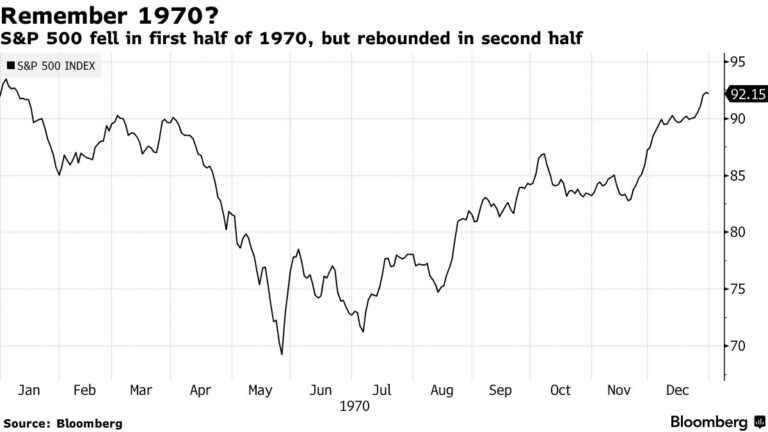
Why 1970? Because we have just experienced the worst first half of the year on the markets since 1970 (when we look at the US S&P500 index). As of June 30, 2022, the S&P 500 index (the 500 largest U.S. companies) is down 20.58%, the NASDAQ (U.S. companies mainly in the technology sector) is down 29.51%, the TSX (Canadian stock exchange) is down 11.26%, Canadian bonds (represented by XBB, an exchange-traded fund) are down 13.59% and global bonds (represented by VGAB, an exchange-traded fund) fell by 13.59%. A bleak picture when you look at the short term, that’s obvious. Now that we know that the decline from January to June 2022 was similar to that of 1970, let’s hope that the months of July to December will also be similar to 1970. A comeback worthy of the New England Patriots in Superbowl 51 who won the game while trailing 28-3 shortly after halftime.
Frequently asked questions
- Could it continue to go down? Yes.
- Could the worst be behind us? Yes.
- Are there any great opportunities right now? Yes, for those with a reasonable time horizon. There are some great opportunities right now, but they may not pay off in the very short term and may take some time to materialize.
- Should we be worried? No. In exchange for obtaining excellent long-term returns, even if most of the time the markets rise, you sometimes have to go through periods of decline.
- Is my future in danger? No. Unless you need to withdraw all of your investments at the bottom of the downturn, time will do things and they will go back up. If you had short-term liquidity needs that were anticipated, your investment strategy was built with that in mind.
- Have I lost my money? No. The value of your investments has decreased. Over time, it will rise again. To lose the money, you would have to withdraw everything, take the loss, have no more investments and miss the rebound when it comes.
- When will we see a rebound? I don’t know. Next week, in a month, in three months; although many people are trying to predict it, no one is able to. What we do know is that there will be one.
- Is it time to make changes to my portfolio? It depends. If you have good investments that are well positioned for the future, even if they are not performing well at the moment, the best thing to do is not to make any changes. If not, there is always time to make changes.
June 2022
After an excellent week to end May and a rather quiet start to June, the situation began to deteriorate around June 9 in anticipation of the publication of inflation figures in the United States, which will have finally been higher than expected. This increase from the previous month was largely due to price increases in the energy and food sectors, as inflation, excluding these two factors, fell for a second consecutive month. These results had the immediate impact of raising expectations for a 75 basis point interest rate hike by the US central bank (which materialized on June 15, 2022), which pushed up interest rates and pushed stocks and bonds lower in tandem. As the month progressed, the conversation began to oscillate between inflation and recession.
Future prospects
Inflation now shares the spotlight with another theme, recession. With inflation, this will be one of the things to watch in the second half of 2022. The risk of recession is increasing, but the degree of such a recession could vary widely. You may also hear about a “technical” recession that the U.S. may already be in as we speak. What is a “technical” recession? It’s a complicated term to talk about a recession that isn’t really a recession. The generally accepted standard for considering an economy to be in recession is a decline in GDP (Gross Domestic Product) for two consecutive quarters. However, in the first quarter, the United States technically experienced a decline in its GDP even though the economy was running at full capacity. A recession scenario is definitely possible, but for your investments, it’s important to remember that markets are always looking ahead. So markets normally go down before a recession is announced and start to rise again while the recession is over.
Quarterly results for companies will be important for the short-term future of the markets in the coming months. The earnings season, i.e. the period when companies announce their results for the last quarter, begins in the next few weeks and this is what will allow us to see if there is a real slowdown in corporate profits. With satisfactory results, it could bode well for the rest of the year on the stock markets. Conversely, volatility is expected to persist.
As for inflation, although newswires prefer to emphasize the negative in the data, there are still encouraging signs. First of all, as mentioned earlier, excluding items with more volatile prices such as energy and food, inflation has actually been on the decline since March. Second, speaking of volatile energy and food prices, oil, natural gas and gasoline prices all declined during the month of June. The same goes for food, with several key elements down in June (wheat, oats, soybeans, etc.). These are good signs that inflation will be absorbed in the future. There are also promising signs for easing supply chain issues (lower container prices, rising inventories, etc.).
In short, there is some good news (even if it is not popular at the moment). The recent problems do not have to be solved in full, but this good news must be maintained and show a trend in the right direction. If we see inflation continuing to slow and stable corporate profits in the second half of 2022, we will be in a good position and that could be very positive.
2022 in examples
This year is a good example of emotional investor behaviour. Benjamin Graham illustrated this well with his concept of Mr Market, where he compared the financial markets to a purely emotional investor who only wanted to buy and sell companies because of the latest news rather than based on the quality of the company. Here are some examples of companies with year-to-date stock performance and earnings (data from Refinitiv as of July 5, 2022):
- JP Morgan, -28.88% since the beginning of 2022, profit in 2021 of $US 48 billion
- Apple, -20.28% since the beginning of 2022, profit in 2021 of $US 100 billion
- Google, -21.81% since the beginning of 2022, profit in 2021 of $US 76 billion
- Bank of America, -29.78% since the beginning of 2022, profit in 2021 of $US 32 billion
- Microsoft, -21.85% since the beginning of 2022, profit in 2021 of $US 71 billion
- Amazon, -31.92% since the beginning of 2022, profit in 2021 of $US 33 billion
- And the list goes on
What to watch for in July:
- July 13: Bank of Canada interest rate decision (0.75% increase expected)
- July 13: U.S. Inflation Data (CPI)
- July 20: Canadian Inflation Data (CPI)
- July 27: U.S. Central Bank decision on interest rates (0.75% increase expected)
- July 28: Advanced estimated data on U.S. GDP
- July 29: U.S. Inflation Data (PCE)
- July 29: Canadian GDP data
As always, I am happy to answer your questions/comments.