
The last few declines had accustomed us to very rapid rebounds and the expression “buy the dip” had become the norm. All we had to do was invest more when the markets were going down and we were rewarded within a few weeks/months. The markets in 2022, however, were difficult markets to navigate the likes of which we hadn’t seen in a long time already. Some people are asking the question, is “buy the dip” dead?
The answer actually depends on the point of view. The idea of investing (or continuing to invest) when markets are falling is still a smart strategy, but you still need to have a reasonable time horizon. In recent years, “buying the dip” worked quickly and in the short term; This explains the rise in popularity of the English expression “buy the dip”. However, applying a systematic investment strategy (investing both when the markets are rising and falling) over the long term brings undeniable benefits. Here is a concrete example to illustrate this.
To keep it simple, let’s take the case of two investors with an identical portfolio consisting of an exchange-traded fund with 60% in equities and 40% in fixed income. The two investors each invested $100,000 on June 21, 2007, before the 2008 financial crisis. The two starting portfolios are identical with the same amount invested at the same time. On the other hand, one of the two investors will never add to his investment, while the second will continue to invest $500/month.
Here is the hypothetical value of the investments as of December 31, 2021:
- Portfolio without automatic investments: $223,606
- Auto-invest portfolio: $373,836
- Total difference between the two scenarios: $150,230
- Additional amount invested in scenario 2: $87,500 ($500/month for 175 months)
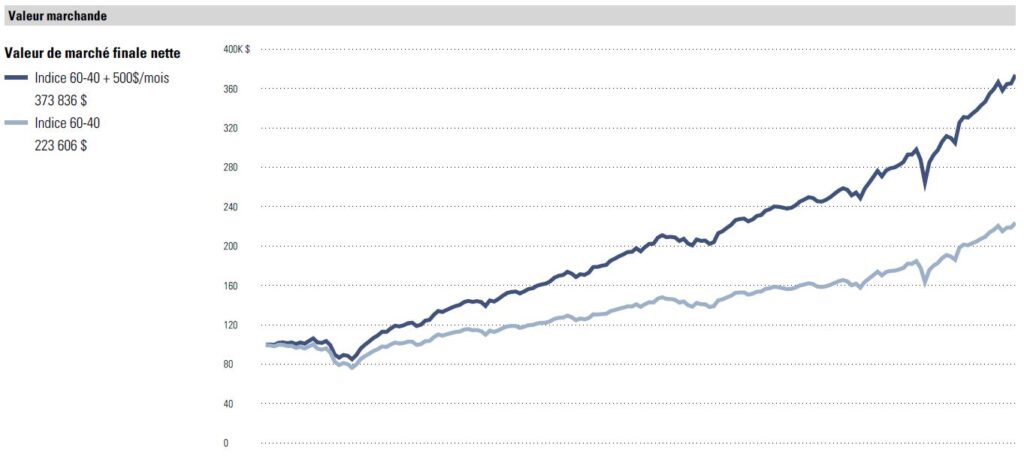
In the end, adding $500 per month to the2nd investor’s portfolio would have made him invest an additional $87,500. However, his portfolio would be worth more than $150,000 more than the first investor who never added any. Why? This capital gain of nearly $63,000 ($150,000 – $87,500) is the result of several factors. First, systematic investing takes emotion out of the equation so that even in 2007 and 2008, when markets were experiencing a significant decline, investing continued and allowed the investor to invest at lower prices. This is also the case during each period of decline that took place between 2007 and the end of 2021. These stocks bought at lower prices benefit more from the rebounds since they were bought “at a discount”. Secondly, you should not underestimate the effect of compound returns, which mean that the longer the amounts are invested, the greater the returns in dollars become, since you are now making a return on a return. For example, you got a 5% return on your $100,000 investment in the first year, so $5,000. In the second year, you still earn a 5% return, but this time on an amount of $105,000 ($100,000 + $5000). Your investment then increases by $5,250 (instead of $5,000 in the first year) even if you haven’t added any money out of your own pocket. And so on for each of the subsequent years.
With systematic investments, the 2ndinvestor invests as much during market declines as it does in the rise; hence the fact of removing emotions from the investment decision. There is no need to “wait for things to calm down” or “wait for them to go down” before investing.
The “buy the dip” is therefore not dead, as long as we remember that sometimes the dip can last several months before recovering. You just have to be patient.