
US equities have just had their worst month since March 2020 and ended a third consecutive quarter down for the first time since 2009 (Bloomberg). The meteoric rise in markets between mid-June and mid-August has been erased and we are back to a lower level than we were in mid-June, at least as far as US equities are concerned. The scenario is a little more divided in terms of bonds; Canadian bonds are still up from mid-June, while global and U.S. bonds are slightly lower.
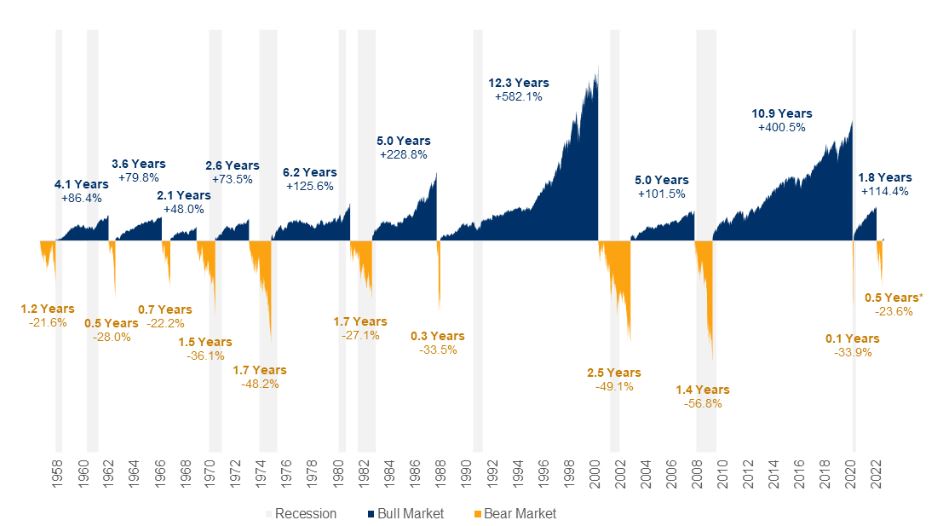
That’s a bleak picture for the first nine months of the year, and since we haven’t seen a prolonged downturn in a long time, some are questioning whether such a long downturn is normal. In fact, if we look at the long term, we quickly notice that the current decline that has lasted for about 9 months now is not particularly abnormal. On the other hand, what we notice is that the last drop of this kind that is the freshest in our memory is that of March 2020. It was this one that was abnormal because of its very short duration. Going back a little further, we quickly notice that historical declines are usually closer to what we are currently experiencing than to that of 2020. This chart provides a good illustration of the bull and bear markets over the years, as well as their durations and associated returns (as of June 15, 2022). We can’t draw any conclusions from this data, but it still helps us put the current 9-month (0.75 year) period in context compared to past bear markets (-20%). The good news when looking at this chart is that periods of bull runs are usually much longer and longer than periods of downturns, making investment in financial markets so attractive over the long term.
Why should I stay invested if my investment goes down?
It’s a good question and one worth asking. The answer is simply that no one knows exactly when things will resume. As presented in my July 2022 commentary (see here), there have already been several occasions this year when we might have thought that the markets were back in the right direction, but we would have been wrong so far. By trying to predict whether each time was the right one, we would have ended up hurting the portfolio more by missing a lot of the hikes and taking the dips. Let’s just imagine an investor who withdraws from the markets after the decline in the first months of the year and then comes back when the markets have recovered 10% (so the investor has not recovered this 10%) by the way that the timing is better, then the markets fall again. The investor is still exiting the market. Then he came back in August after the recovery of more than 15% (a recovery from which he did not benefit) and the markets fell another time. This investor is in much worse shape than the one who has remained invested through the entire period. That answers the question I often receive, which is why stay invested when the markets are going down. We know that the markets will recover, but we do not know when. And when we know that they have finally turned the corner, the rise will already be well underway.
About September 2022
September had started relatively well, but very poor U.S. (AP) inflation data released on September 13 tipped the scales; with US stock markets having their worst day since 2020 (Bloomberg). High inflation data led some investors to believe that a 1% increase in the US central bank’s key rate was in the cards for the meeting scheduled for the following week (an increase that did not materialize since the Fed chose instead to go with 0.75%).
About a week later, a second slump for the markets when the Fed’s decision (US central bank) was announced. On the other hand, the bad news did not come from the rise in interest rates as such (0.75%), but from the “dot plot”. What is this famous “dot plot” that has had such a big impact on the markets? These are in fact the forecasts of the members of the US central bank regarding the future of interest rates. This is where the real surprise was hidden. In fact, the prospects presented at that time were much better than the last; This implied a continued rise and a continuation of restrictive monetary policies in the future. This is followed by a sharp rise in future interest rates on the financial markets which, as you now know, leads to a decline in both stocks and bonds.
On our side of the border, the news has been a little better on inflation. The Canadian inflation data released during the month of September were encouraging because, unlike our neighbours to the south, there were signs of a reduction in inflation across the vast majority of categories. The Canadian stock market has consequently performed better than its U.S. counterpart, a trend that has been observed since the beginning of the year.
On the road to the last quarter of 2022
Now that the third quarter of the year is over, we are looking ahead to the4th and final quarter of 2022. Once again, several things to watch during the last three months of the year, including of course the evolution of inflation, the economic situation, the elections and much more. A busy program once again, but which we hope will give us more positive news.
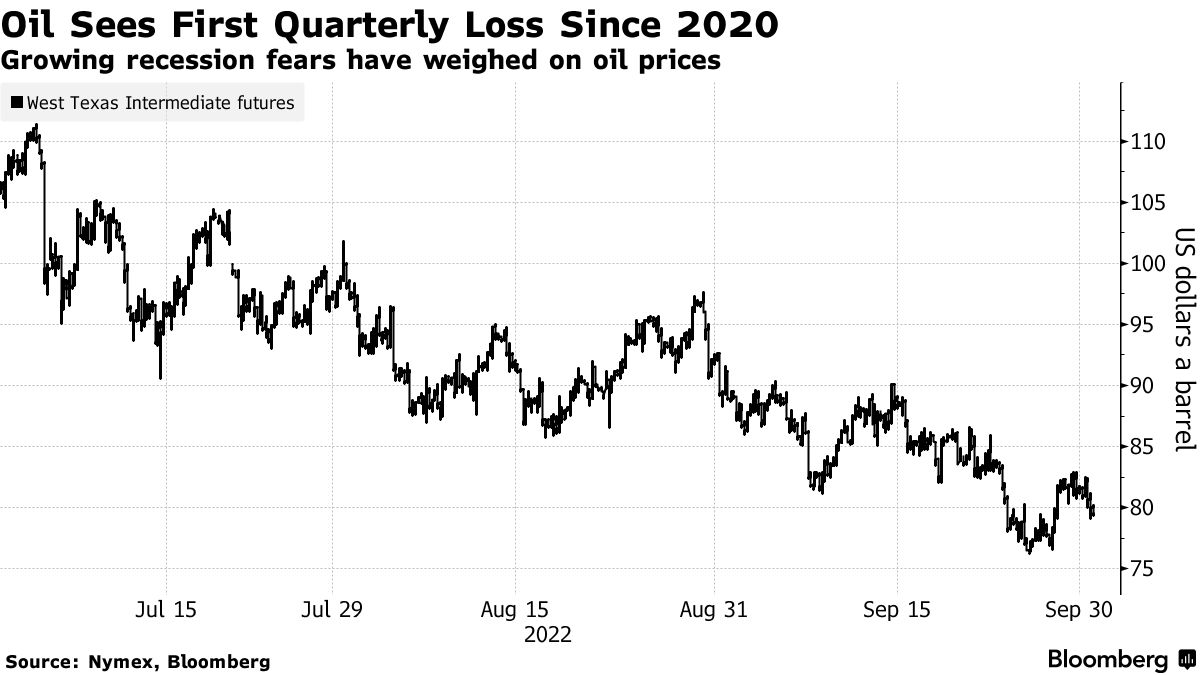
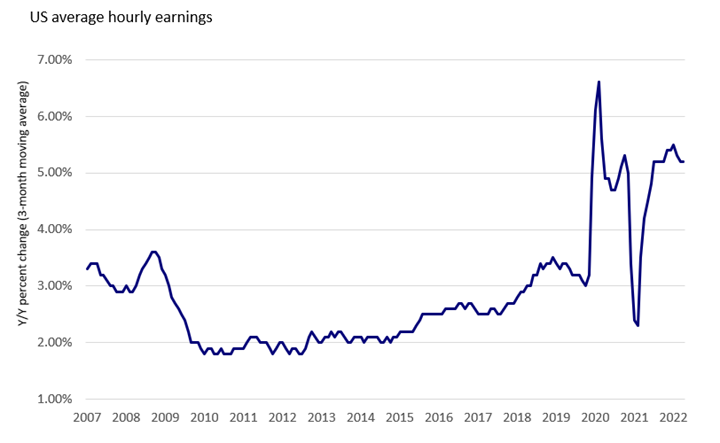
It will be interesting to see if the August inflation data was just an outlier or if it is really entrenched. If this were just an aberration, it would of course be excellent news for the markets. Some data still points to a decline in inflation in the future, but as discussed in my last comments (see here), we will have to see a trend to be able to conclude that the decline is real. The price of a barrel of oil fell by nearly 25% during the quarter, its first quarterly decline since 2020, and wages appear to have peaked (although this data is only very recent). Also coming are more cautious comments from a few Fed officials about rate hikes and their impacts, an encouraging sign that could lead to a less aggressive approach that would be well received by markets (CNBC).
In Canada, the latest data gives hope for the downward trajectory of the CPI (Consumer Price Index, a measure of inflation). If the trend continues, the Bank of Canada may be tempted to reduce the speed of its interest rate hikes or the terminal (maximum) rate since the latest hikes already seem to be being felt. I wouldn’t be surprised if the Bank of Canada’s terminal rate is lower than the U.S. central bank’s given the Canadian economy’s higher sensitivity to interest rates relative to the U.S. economy.
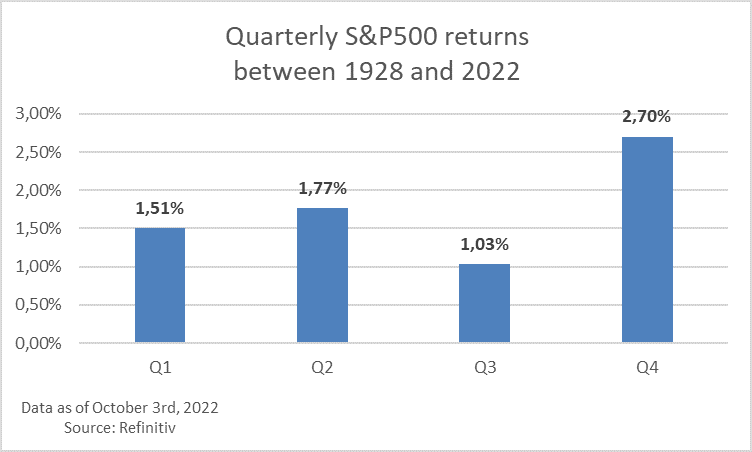
To end on a positive note, here is a historical context of the US stock market’s returns through the different quarters of the year. I had fun (to each his own!) pulling out the S&P500 performance data between 1928 and 2022 to see historically what the returns of the different quarters have been. You may be happy to know that we have just completed the worst quarter of returns on record and are entering the best. Of course, past performance is no guarantee of future performance, but a little positivity can only do good this year.
Do not hesitate to contact me to share your comments and questions.