The year started strong with inflation expectations falling and hopes that the U.S. Federal Reserve may have finished its job of raising interest rates. That same hope quickly evaporated when new inflation data came out, pointing to sluggish-than-expected inflation and bringing fears of future monetary tightening back to the forefront. In the end, we were treated to two of the largest bank failures in U.S. history and the collapse of a Swiss bank that had been in existence for more than 100 years.
Despite all the negative news we hear and make headlines, you may be surprised to learn that despite everything, the stock markets were positive in the first quarter. They were also for a 2ndconsecutive quarter if we go back to the last quarter of 2022. As you have heard me say several times, I do not have a crystal ball to know where the next few months will go and whether this increase will be sustained. What I know for sure is that very few people expected a good start to the year and that’s what we got anyway. There are thirteen to a dozen short-term market predictions and they attract a lot of attention (especially if they are negative). However, the vast majority of people invest for the long term and it has been proven time and time again that trying to “time” the market, i.e. trying to get in and out of the market “at the right time”, is one of the worst strategies an investor can adopt. So, will the market be positive in the next quarter? It’s up to you to tell me.
If we go back any longer, someone looking at their statement today for the first time since last summer(June 1 , 2022) would probably find that the value is virtually unchanged. On the other hand, a person who, over the same period, would have consulted his account every day would not have had the same experience at all since the market movements during this period were very important. Looking at it on a daily basis, it would have experienced several variations of more than 10%, both upwards and downwards. It goes to show that sometimes the famous advice not to look at your investment account every day during periods of volatility is always relevant.
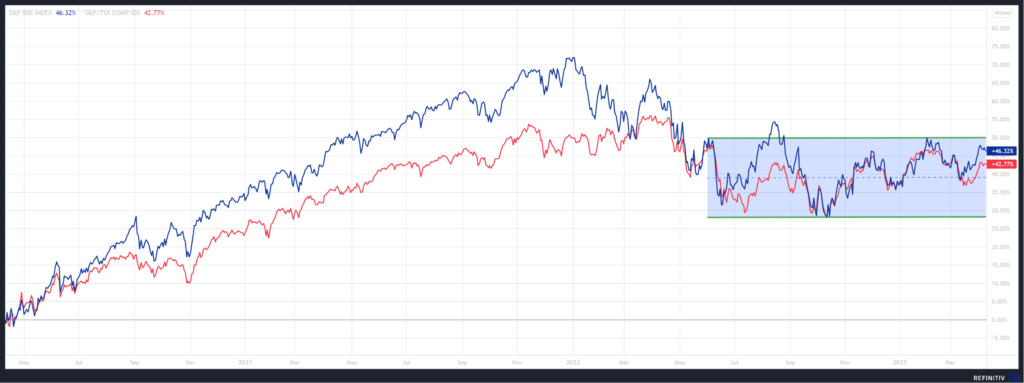
As shown in the previous chart, the market has been looking for a direction for several months; which is not unusual during periods of economic uncertainty. With the amount of events that have been happening lately, there is a lot of uncertainty, but it is starting to dissipate little by little, and this is what will help the markets lay the foundations for the next cycle.
Banking crisis
As in 2022, inflation and recession were in the spotlight in the first quarter of 2023. The banking crisis has been added to the list of important events to impact the markets over the last 15-18 months.
In short, the banking crisis began when, at the beginning of March, Silicon Valley Bank (SVB) tried and failed to raise new capital. This failure sent a very negative message about SVB and its financial health. Panic then gripped the bank’s customers and, on Thursday, March 9, 2023, they withdrew $US 42 billion in a single day. The technological environment that allows us to open accounts and transfer our money from one institution to another in a very short period of time has certainly helped to accelerate the bank’s downfall since such large withdrawals in a single day from the same institution would not have been possible only a few years ago. When the panic began to spread, it spread like wildfire.
Now, why was Silicon Valley Bank’s financial health precarious? The boom in investments in new technology companies, SVB’s main customer base, during the pandemic has led to a very strong growth in the deposit of money from these companies into their bank accounts. At the same time, interest rates were at the bottom as central banks had cut them to support the economy during the pandemic. SVB, having to invest the large deposits they received from their customers, then decided to invest them in longer-term safety bonds in an attempt to get a slightly higher return on these deposits. As you now know, these longer-term bonds are also more sensitive to interest rate movements and these interest rates have risen very significantly in 2022; resulting in a substantial decrease in the value of the bonds held by SVB. As a general rule, these cuts in themselves would not have had such a significant impact on the bank since it is only theoretical. Indeed, by holding the bonds until their maturity (maturity date), SVB would then have recovered this decrease in addition to having continued to collect their interest payments each year. However, they were not able to hold these bonds to maturity as large withdrawal requests forced them to sell bonds before and thus realize a loss. On top of all that, SVB’s target customers weren’t getting as much money infusion in 2022 as they did in 2020 and 2021. New tech companies were more in “withdrawal” mode than in “deposit” mode last year, adding to the bank’s troubles.
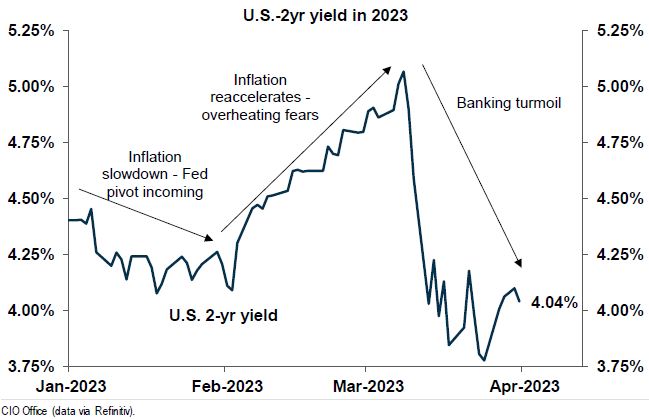
Government authorities responded quickly by putting in place new measures to prevent the fear from spreading to the banking system in general, which could have had much greater consequences for the future. Banks around the world have nevertheless been under the microscope and have felt the repercussions. Still, the fears spread to other institutions, forcing the closure of the Signature Bank in New York and the purchase of Credit Suisse by its competitor, UBS. All this volatility has also resulted in very strong movements in interest rates, as shown in the chart below illustrating the evolution of the US 2-year rate since the beginning of the year.
For now, it seems that contagion is limited and that the main problems have been resolved, but that doesn’t mean that others will never be impacted. There are about 4,700 institutions covered by the FDIC in the United States compared to only 85 covered by the CDIC in Canada. Our banking systems are fundamentally different, you will agree. Interestingly, North Dakota, a U.S. state with fewer than 800,000 people, has more banks than Canada as a whole (Bloomberg).
Conclusion
In conclusion, after a busy first quarter, but all in all good when looking at portfolio returns; We will have a lot to follow in the coming quarters. Recent inflation data seems to point in the right direction, although it remains fragile. The economy is strong, although cracks seem to be appearing and some sectors such as technology may have already experienced their recession. The repercussions and impacts of the banking crisis also remain to be measured because it would not be surprising to see banking institutions tighten their credit conditions and reduce the volume of loans they make to their individual and commercial customers. Such tightening could impact financial conditions and act similarly to an interest rate hike; perhaps allowing the US Federal Reserve to take a break from its interest rate hikes.
Do not hesitate if you have any questions or would like to discuss them further.