
You may have already heard it in the media or in your entourage, but April was the worst month since November 2008 for the technology sector (represented by the NASDAQ index), while the S&P500 index of the 500 largest American companies had its worst month since March 2020 when the pandemic arrived.
Depressing? These are not pleasant times to live I admit, but they are part of the vagaries of the stock market and the financial markets. Once again I repeat myself, but the important thing is to keep the goal in mind and let time do its work. Emotions guide the market in the short term, but not in the long term.
Despite the broad strokes, there is not only bad news in the markets at the moment. We are currently in the earnings season, i.e. the period when companies unveil their financial results for the last quarter. With the market movements, one would be tempted to believe that the results have been disappointing so far, but on the contrary. In fact, until last Friday, 77% of the companies that have reported their results have performed better than expected. However, this good news has been buried by interest rate expectations stemming from fears about inflation and its impact on the economy (see my first-quarter commentary). While macro news is dominating the headlines right now, eventually, good fundamentals will be rewarded. I also believe that the worst is behind us in terms of bonds. Of course, it is impossible to predict the absolute bottom, but with many hikes already priced in the markets, the future looks brighter to me in this asset class. Investment grade bonds should therefore do well to serve their role as a diversifier and protector in a portfolio when needed in the future.
Returns have been disappointing recently, but let’s remember that including this decline, we have still had exceptional returns in recent years. Technology (represented by the NASDAQ index) is up 106% over the last 5 years and the US market (represented by the S&P 500) is up 74% over the same period. Corrections like what we are currently experiencing give the markets a necessary “reset” for the upward trend to return.
Before my quiz question, here are a few illustrations that demonstrate the vagaries of the markets we are talking about and the importance of staying invested through these periods. Large declines are commonplace, but increases are even more common. Periods of high volatility, such as the one we are currently experiencing, are also periods during which there are significant days of upward volatility (no need to look further than mid-March 2022). The second chart shows the impact of missing the best days on a long-term investment. The third shows the normal cycle of investors’ emotions. It’s up to you to see if you recognize yourself in it (but I’m sure not…!)
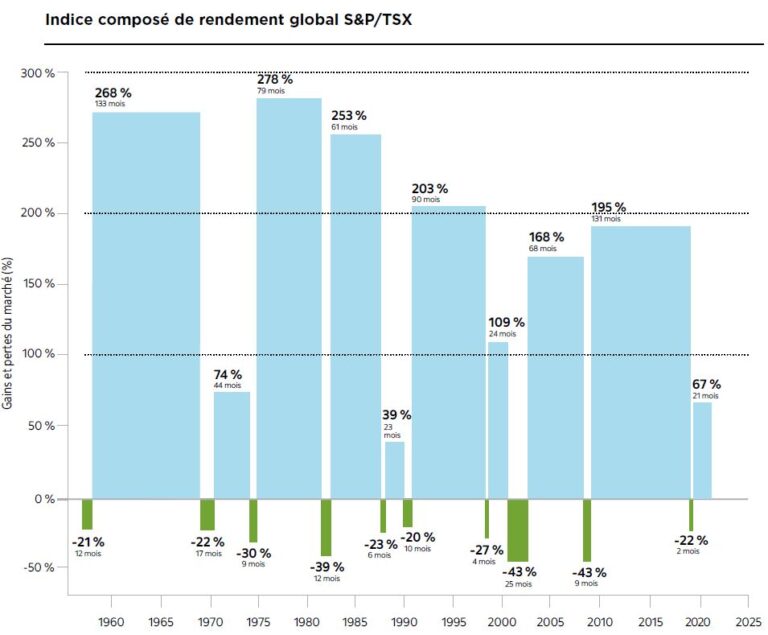
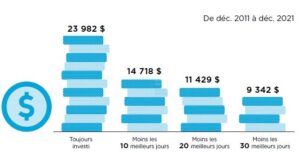
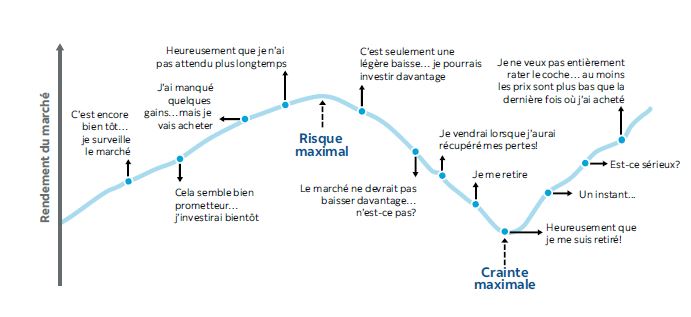
Source: Dynamic Funds, returns used for examples are those of the Canadian S&P/TSX stock exchange.
Question Quiz
Here is the chart of the share price of a well-known company between December 10, 1999, when the stock was trading at $111.40 USD, and September 28, 2001, when the stock was now trading at $5.97 USD. This change represented a decrease (and I specify here a decrease and not a loss) of 94%. Could you tell me which company it is? Hint: This company still exists and is known worldwide. Would you have kept your shares? Or would you have even invested in this company?
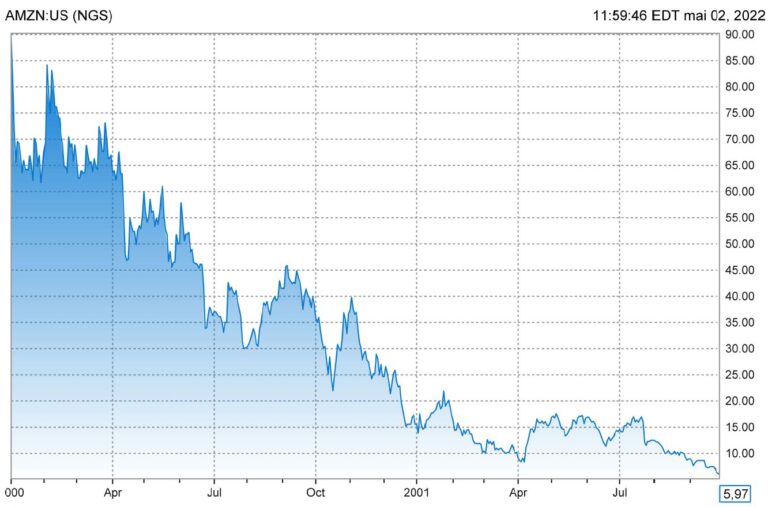
Here is the evolution of this company’s share price thereafter, between September 28, 2001 and May 2, 2022:
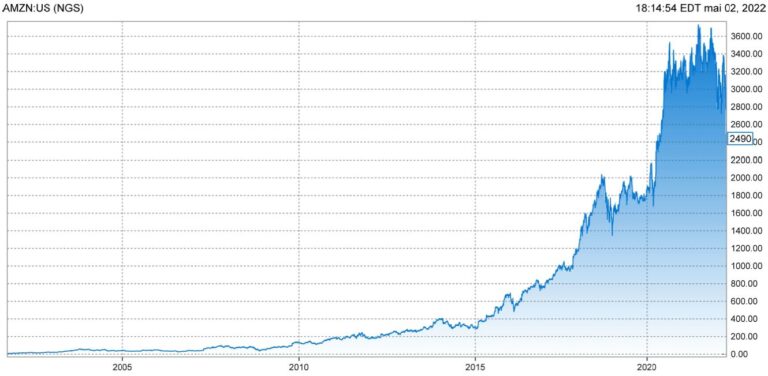
If you had said Amazon, good answer! (A return of 40,061% for those who are wondering).
Now, we agree that Amazon is a special case (although not the only one) of phenomenal growth over time, but few people remember that at one point they had lost 94% of their value on the stock market. Amazon wasn’t the company it is today in 2000 and 2001, but it had already evolved significantly from its origins in book sales. By 1999, they had already sold 20 million items (books, CDs, toys, electronics, tools, etc.) in 150 countries around the world. In the year 2000, they opened up their platform so that merchants outside of Amazon could use it to sell their products.
It goes to show that in investing, emotions are not always good advice in more difficult times.
I hope you enjoyed reading this and I am always available if you have any questions/comments.